

Agrarian South Network — Featured resource on Unlearning Capitalism
Agrarian South Network
The Agrarian South Network (ASN) is a tri‑continental network of researchers in Africa, Asia, Latin America and the Caribbean, with an interest in land, labour, and agrarian questions and the political economy of world development.
About
The Network was born of the initiative of Professor Sam Moyo at the African Institute for Agrarian Studies (AIAS) in Harare, Zimbabwe, in collaboration with public universities and non-governmental partners. The first steps of the Network were taken together with the founding of AIAS in 2002, in synergy with other South-South research initiatives led by the Third World Forum, CODESRIA, CLACSO, and IDEAS.
The network was consolidated in 2012, with the launch of our periodical scientific publication, Agrarian South: Journal of Political Economy.
ASN maintains its secretariat at the (renamed) Sam Moyo African Institute for Agrarian Studies (SMAIAS), in Harare, and today includes as its primary network partners the Centre for Agrarian Reform and Education for South (CARES), in New Delhi, and Coletivo Novo Bandung, in São Paulo, as well as many more supporting partners across the world which actively contribute to ASN activities and research projects.
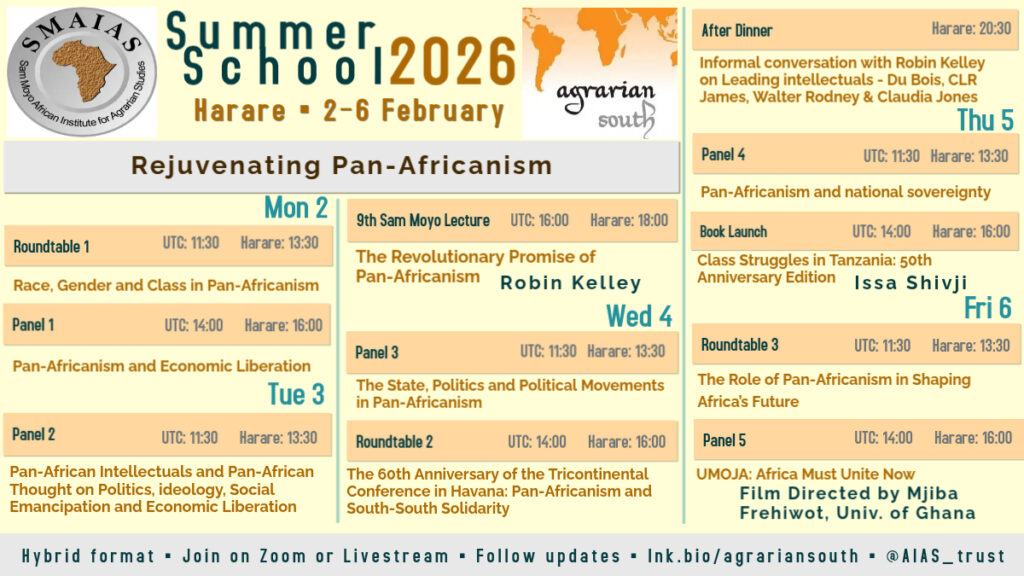
The Network organizes a wide array of research initiatives and scientific publications. The annual Summer School, held in collaboration with SMAIAS in Harare, is the main activity since 2009, where new research is presented and ideas discussed in a week-long session. The Agrarian Studies Training Institute is a two-week course held occasionally for post-graduate students where methodological and theoretical issues are discussed. The Dialogue Series occurs regularly in vitual format since 2020, with lectures, book launches and other events. The Study Group is a year-long activity in virtual format since 2021, which provides for a collective reflection on fundamental issues in the social sciences.
The publications of the Network include a Research Bulletin published every two months with short articles on current theoretical and political concerns, as well two book series: the South-South Book Series, which has been producing collaborative tri-continental research since 2005, and the Short Book Series, launched in 2022 as an e-book series aiming to popularize important contributions on theory and praxis.
The Network organizes the annual Sam Moyo Memorial Lecture, in tribute to the visionary and indefatigable founder of our Network and founding Editor-in-Chief of Agrarian South. The journal also awards the Samir Amin Young Scholars’ Prize in Political Economy of Development, in honour of Amin’s path-breaking work in political economy and exemplary dedication to the liberation of the peoples of the South.
The mission of the Network is to produce innovative research on the political economy of world development, build autonomous research capacity in the South, promote the intellectual traditions of the Third World, and cultivate tricontinental solidarity among the new generations.
The Agrarian South Network is not a legal entity and does not receive direct funding.
The objectives of the network are to:
- promote research and debate on land, labour and agrarian questions towards an alternative, just and sustainable world order;
- produce knowledge relevant to the realities and ambitions of the peoples of the South;
- facilitate South-South and socially engaged research by means of systematic dialogue between researchers and activists;
- develop autonomous capacity for research and publication and intervene effectively in national and global debates;
- provide advanced training in political economy and research methods related to land, agrarian and labour questions;
- cultivate a gender sensitive research agenda and professional environment.